


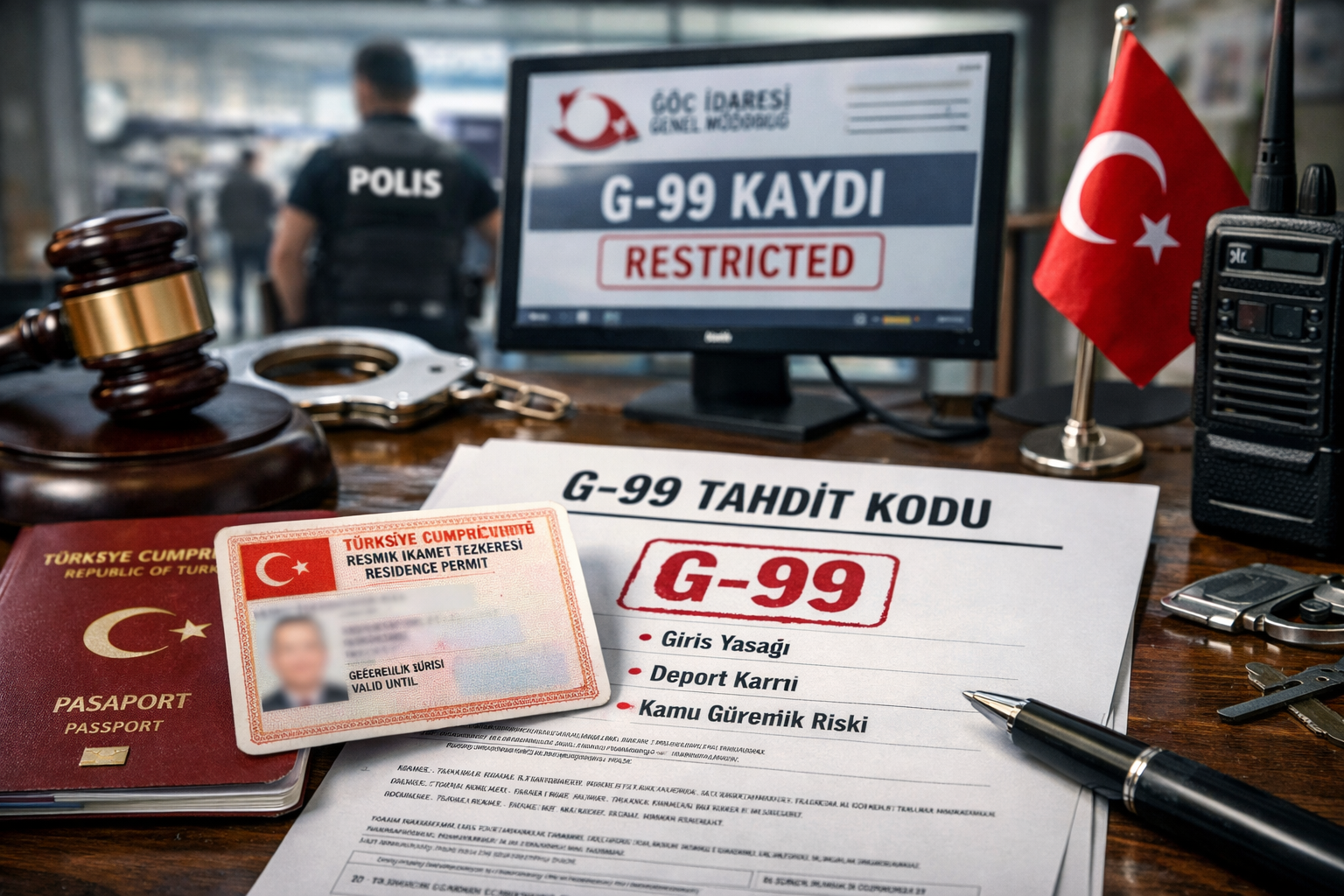

What Is the G-99 Restriction Code? Official and Up-to-Date Information on G-99 in Türkiye
Foreign nationals who wish to enter Türkiye or reside in the country lawfully may, in certain situations, encounter restriction (tahdit) codes. One of the most frequently questioned codes in practice is the G-99 restriction code. However, incomplete or inaccurate information about this code often circulates in public sources.
In this article, we explain what the G-99 code means, in which situations the authorities use it, its legal basis, its possible consequences, and the available legal remedies, all within the framework of current Turkish legislation.
What Is the G-99 Restriction Code?
The G-99 restriction code is an administrative restriction code that migration authorities enter into the system following an assessment related to public order and public security concerning a foreign national.
It is important to emphasize the following point:
Neither Turkish legislation nor the Official Gazette (Resmi Gazete) publishes an open or officially approved list of restriction codes in which the G-99 code is specifically defined.
Nevertheless, Göç İdaresi Başkanlığı (the Directorate of Migration Management) and relevant security authorities use this code internally within their administrative systems as a technical classification tool.
What Is the Legal Basis for the G-99 Code?
Restriction codes themselves do not constitute independent legal provisions. However, migration authorities enter such codes by exercising the powers granted to them by law.
The primary legal framework governing this matter is Law No. 6458 on Foreigners and International Protection.
Under this law, the authorities:
determine the conditions for foreigners’ entry into Türkiye;
regulate the rules of stay;
conduct deportation procedures;
take administrative measures based on public order and public security considerations.
Accordingly, the authorities enter the G-99 code when they identify a risk to public order or public security.
Important:
The law does not contain a direct definition or description of the G-99 code. The authorities use this code solely as an administrative and technical indicator.
In Which Situations Does the G-99 Code Appear?
An analysis of practical cases shows that migration authorities most commonly use the G-99 code in the following situations:
when they assess a foreign national as posing a potential risk to public order or public security;
when the case file requires additional or special review by security authorities;
when the situation does not fall under standard G-category codes but still necessitates administrative measures;
in cases involving foreign nationals who are already subject to a deportation decision or an entry ban.
It should also be clearly stated that:
The presence of a G-99 code does not automatically indicate that a crime has been committed.
In most cases, the authorities use it as the result of a preventive administrative risk assessment.
Does the G-99 Code Mean Deportation or an Entry Ban?
No. These are distinct legal concepts.
The G-99 code is an administrative marker within the system.
Deportation is a separate, written, and reasoned administrative decision.
An entry ban is an independent measure that prevents entry into Türkiye for a specified period.
However, in practice, the presence of a G-99 code may lead to:
refusal of entry at the border;
cancellation of an existing residence permit;
initiation of deportation proceedings.
For this reason, each case requires an individual legal assessment based on its specific facts.
How Can One Officially Learn Whether a G-99 Code Exists?
The authorities do not publish a public list of restriction codes. Nevertheless, a foreign national may learn about the existence of a G-99 code through:
checks conducted within the Directorate of Migration Management’s system;
documents issued at border crossings (such as a “Refusal of Entry” form);
system reviews carried out during visa or residence permit applications.
Legally binding and definitive information can be obtained only from official administrative records.
Can the G-99 Restriction Code Be Removed?
Yes. With the correct legal approach, the G-99 restriction code can be challenged and removed.
In practice, the following steps are commonly taken:
submitting an administrative application to learn the legal grounds for the code;
filing an annulment lawsuit before the Administrative Court;
requesting a stay of execution when necessary;
submitting evidence and legal arguments tailored to the specific case.
Each case has its own characteristics. Therefore, the legal strategy must be determined individually.
Final Legal Assessment
In summary:
the G-99 restriction code is not a criminal classification or an offense in itself;
the authorities apply it within the scope of their powers under Law No. 6458;
each situation must be evaluated on its own merits;
with timely and proper legal action, removal or annulment of the G-99 code is possible.
