


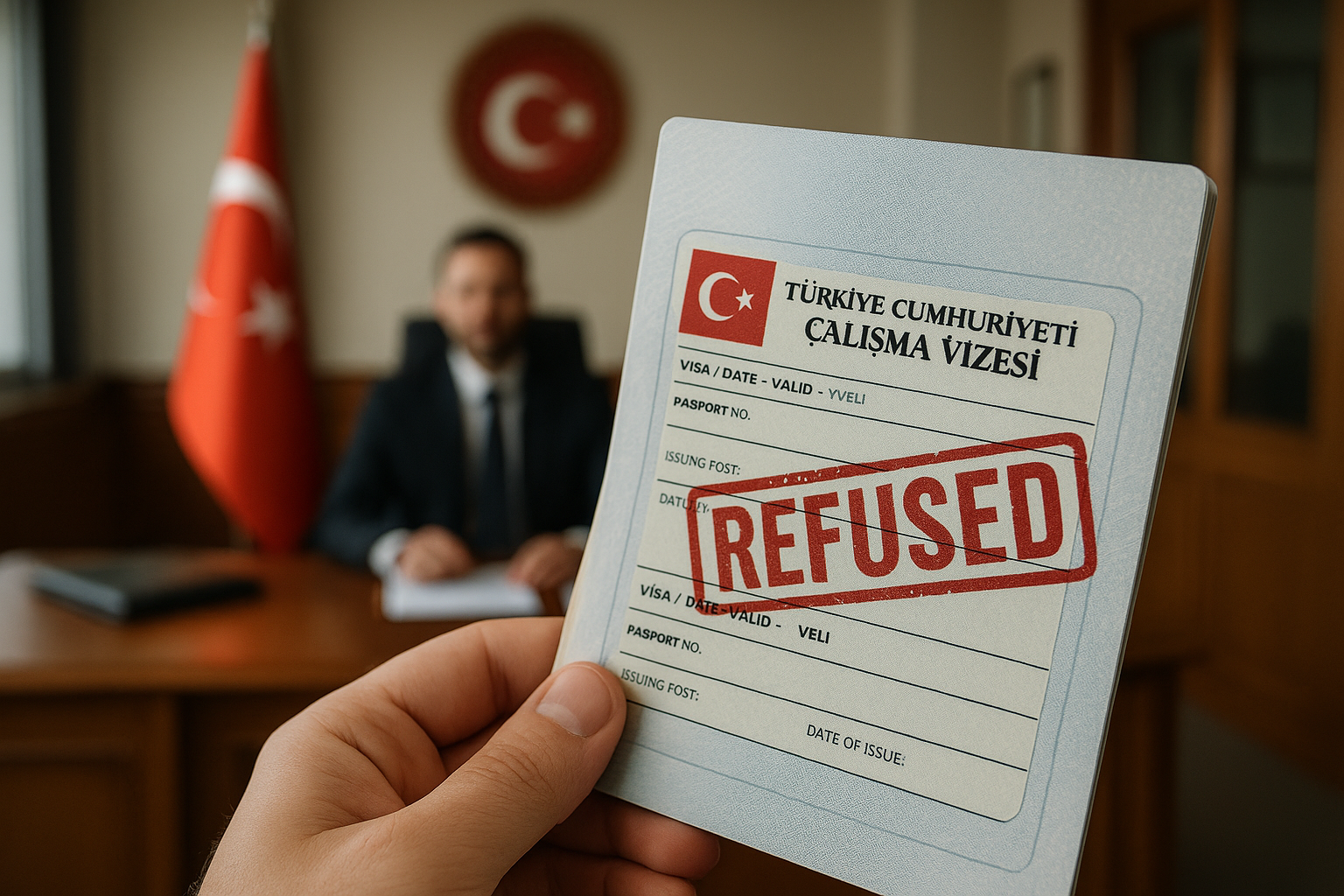

Turkey Work Visa Refusal: 10 Reasons and How to Avoid It in 2025
Turkey work visa refusal has become one of the most common issues foreign workers face in 2024–2025. Many applicants receive refusals due to incorrect documents, employer non-compliance, or improperly prepared applications. Therefore, understanding the process and preparing correctly before applying is extremely important. Additionally, proper preparation significantly increases the chance of approval.
Why Did Work Visa Refusals Increase in 2025?
Work visa refusal rates have risen steadily in recent years. Tighter inspections by the Ministry of Labour, increased automated checks through e-Government systems, and a rise in fraudulent applications all contribute to this trend. Moreover, sector-specific quota reductions also play a role. Especially, enhanced digital verification systems detect document inconsistencies immediately.
You can check your application status here:
Official Directorate of Migration Management
Top 10 Reasons for Turkey Work Visa Refusal
1. Employer Not Meeting Ministry Requirements
An employer must meet several criteria to hire a foreign worker. These include hiring at least five Turkish employees per foreign worker, having no SGK or tax debt, and actively conducting business. Additionally, the employer’s financial records directly affect the evaluation.
More information:
SGK Official Website
2. Errors in the Employment Contract
Incorrect job titles, inaccurate salary amounts, missing signatures, or non-standard contract formats lead to refusal. Therefore, preparing a complete and accurate employment contract is essential. In addition, the contract must comply with Ministry standards.
More details:
Ministry of Labour
3. Salary Below the Legal Threshold
The Ministry applies specific salary coefficients based on position:
Hotel staff: minimum ×1.5
Specialist roles: minimum ×2
Managerial roles: minimum ×3–4
When the declared salary falls below these levels, the application is rejected. Thus, providing the correct salary is crucial.
4. Qualification Mismatch
The applicant’s education, professional experience, and skills must match the position. The Ministry compares the candidate’s background to the job requirements. If there is a mismatch, the application is refused. Therefore, ensuring position suitability is essential.
5. Document Errors
Incorrect translations, missing apostilles, date inconsistencies, or low-quality scans weaken the application. In particular, even a small error can stop the process. For this reason, all documents must be accurate, complete, and readable.
For related residence permit refusals, read:
Residence Permit Refusal — Reasons and Solutions
6. Poor Quality Photos or Scans
The e-Application system does not accept blurred, cropped, dark, or low-resolution documents. Thus, applicants must upload clear and high-quality images. Additionally, using the correct file format is important.
7. Deportation Records or N-Codes
Active deportation status, entry bans, or N-codes (such as N-82 or N-99) block the work visa process. Authorities review these codes and refuse applications when risks exist. Especially, N-codes pose a serious obstacle for work visa approval.
More information:
Foreigners’ Right to File a Complaint
8. Missed Application Deadlines
Late document uploads, delays after consulate appointments, or exceeding the 30-day employer upload period cause immediate refusal. In short, timing is a critical factor. Moreover, the system automatically detects delays.
9. Employer’s Penalties or Negative Records
Employers with SGK debt, tax penalties, or previous violations have higher refusal rates. Therefore, checking the employer’s background before applying is beneficial. On the other hand, a clean employer record increases approval chances.
More information:
Ministry of Treasury and Finance
10. Suspicion of Fake Employment
If the company does not actively operate, has very few employees, or lacks financial activity, the Ministry may suspect fake employment. As a result, the application is refused. Thus, proving a genuine employment relationship is crucial.
How to Avoid Turkey Work Visa Refusal in 2025
1. Verify the Employer in Advance
This step significantly increases the chance of approval.
2. Prepare All Documents Correctly
Additionally, ensure that all documents are consistent, complete, and readable.
3. Prepare the Employment Contract Properly
Even a minor contract error may lead to refusal. Therefore, drafting it correctly is essential.
4. Follow e-Application Steps Carefully
File quality and data accuracy determine the result. Furthermore, avoid formatting mistakes during upload.
5. Check Deportation and N-Codes
(You may add a WhatsApp button here if needed.)
6. Submit All Documents on Time
Avoid last-minute submissions to reduce refusal risk.
7. Get a Legal Pre-Check Before Applying
As a result, professional review prevents most errors early.
What to Do After a Work Visa Refusal?
You can reapply after correcting the issue.
You can change employers.
You can remove deport/N-codes.
You can receive professional legal assistance.
Job Groups That Receive the Most Refusals
Hotel staff
Cleaning staff
Kitchen assistants
Low-skilled workers
Conclusion
Turkey work visa refusal can largely be avoided through proper preparation, document accuracy, and strong employer compliance. Additionally, careful submission and early verification significantly increase approval chances.
If you need professional assistance with your work visa application, the CR Partners team can support you throughout the process.
Contact us via WhatsApp for guidance and quick assistance.
FAQ — Frequently Asked Questions
Can I reapply after a refusal?
Yes, if the underlying issue is corrected.
Does deportation affect work visa approval?
Yes, until the deport status is removed.
Can I change employers?
Yes, but a new application is required.
How long does a work visa take?
Usually around 30 days.
Is pre-checking documents important?
Absolutely — it significantly reduces refusal risk.
